
I’ve wanted to be a pilot since I was three or four years old. One of my earliest memories is of a weekend trip to Myrtle Beach. On the way there, I sat in my grandfather David’s lap in the cockpit of a King Air C90.
I squeezed his hand in fear as the pilot yelled out the window, “clear prop!” The plane’s Pratt & Whitney turboprops roared to life; first the right, then the left. The sense of fear that had captured me dissipated quickly as the choking and spiting of the engines morphed into a loud but soothing hum. Looking back, I imagine that I felt safe there with him between those whirling blades, maybe safer than I’ve ever felt since.
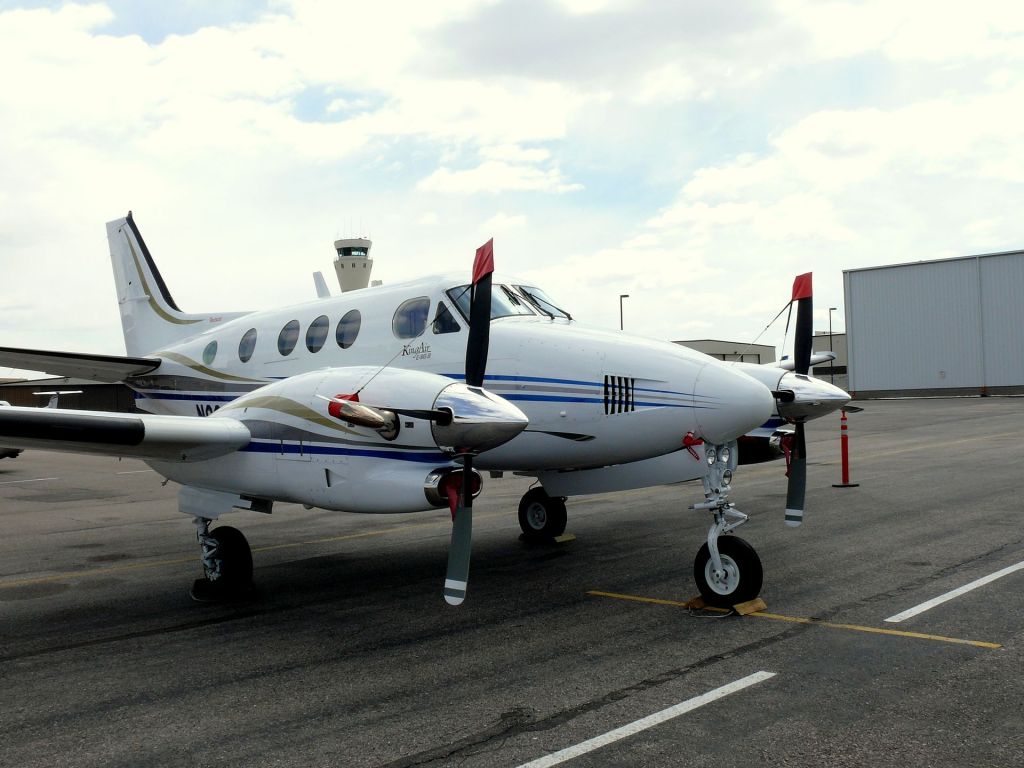
My grandfather died several years later, but my grandmother, Katie, continued receiving monthly issues of his favorite aerospace magazines. One afternoon she noticed me thumbing through a copy of Executive Controller. From that day until she moved into a new home, she passed every issue on to me.
I was hooked! Whenever I arrived for a weekend visit, I made a bee-line for the kitchen where she kept her mail. I pulled the relevant magazines out from under the pile, ripped off their plastic covers, and started reading. After memorizing performance, weight, and balance stats for the major aircraft classes, I set to work categorizing them by average operating cost, useful load, and early environmental impact estimates. Within a few months, I could look at a plane flying overhead and tell people much more about it than they ever wanted to know!
I finished my term of service as a pastor at Bryn Mawr Presbyterian Church in June of 2019, but I wasn’t scheduled to start school in Bonn until the end of September. Never one to find grace in being idle, I needed a mission in the meantime.
It occurred to me that I might never have a better opportunity to work toward my life-long dream of becoming a pilot.
I called a local flight school and signed up! One week later, I was standing with my instructor on the ramp of Hickory Regional Airport, conducting my first preflight inspection. Thirty minutes after that, I was in the air, and my instructor was introducing me to the flight control systems.

The months that followed were anything but a relaxing vacation. I spent most mornings at the airport or in the sky, building skills, and getting to know the Cessna 172’s I was privileged to fly. In the afternoons and evenings, I worked through “ground school” materials gaining additional knowledge of aerodynamics, flight instruments, FAA regulations, navigation, weather systems, and cross-country flight planning.
One Sunday afternoon, I received an unexpected call from my flight instructor. A local aircraft leasing company had acquired a 1976 Cessna Skyhawk II with a U.S. Bicentennial Edition paint-job and an engine modification that gave it twenty-extra horsepower. He invited me to tag along on an in-flight inspection of the newly purchased craft.
Excited by the opportunity to log a free hour of flight-time, I agreed to meet him early the next morning.
When I first approached the plane, I could tell it had been left outside of the hangar for too long. The red, white, and blue stripes on the fuselage were faded and cracked. It needed some TLC. Thankfully, the wear-and-tear was cosmetic; Everything seemed to be in working order.
We completed our preflight evaluation, settled in, went through the checklist, contacted the tower for clearance, and made our way off the ramp & down the taxiway. The next stop was the runway threshold. We got takeoff clearance and ran through another checklist. Then, we were off.
Racing down the runway, we hit 60 knots. We rotated and were airborne.
“Oh, shit!” I shouted into the headset. The latch on my cabin door had released!
My eyes fixated on the quickly receding airfield beneath me. “Lean back,” my instructor commanded. “I’m going to bank left. The pressure will force the door closed.” I leaned back. He banked, but the door wouldn’t re-latch. “We’re going to try it again,” he said. “This time, you have to push the door open while I rotate. Then, pull it shut.”
“Oh, sure,” I thought sarcastically. “Let’s turn the plane so that I’m dangling over thin air and then push the door that is holding me in this God-forsaken death trap even further open; That sounds like a great idea!”
Setting aside my doubts, I obeyed. It wouldn’t bode well for his CV if he dumped a student out of a plane. He must have known something I didn’t.
It worked! The door re-latched!

Once on the ground, we taxied to the service hangar. The experienced mechanic knew immediately what had happened. According to him, door latches on old Skyhawks are notorious for popping open mid-flight. A 2.5-inch spring was incorporated into the door handle, which made it easier to open and close the doors. After years of use, the springs weakened, and problems arose. His radical solution to the problem was to grab a screwdriver and remove the spring. It took three minutes, and the door works fine without it.
In truth, I was never in serious danger; A fact of which I should have been aware.
Unpressurized planes are capable of flying quite effectively without doors. Plus, the force of the wind relative to the aircraft was actually holding the door closed, even if the handle wasn’t securely latched. I caught a glimpse of the ground beneath me because the force of the latch’s initial release was greater than that of the pressure being exerted on the fuselage by the wind. The safest option in such situations is to do exactly what my instructor did, even if it seemed crazy to me at the time.
In that adrenaline-filled moment, my earth-bound mind tricked itself into believing that he was about to dump me out onto the parking-lot 2,000 feet below! In fact, by rotating left, he increased the air pressure on my side of the plane. When I pushed the door open, the pressure helped me slam it shut while the seatbelt held me securely inside.
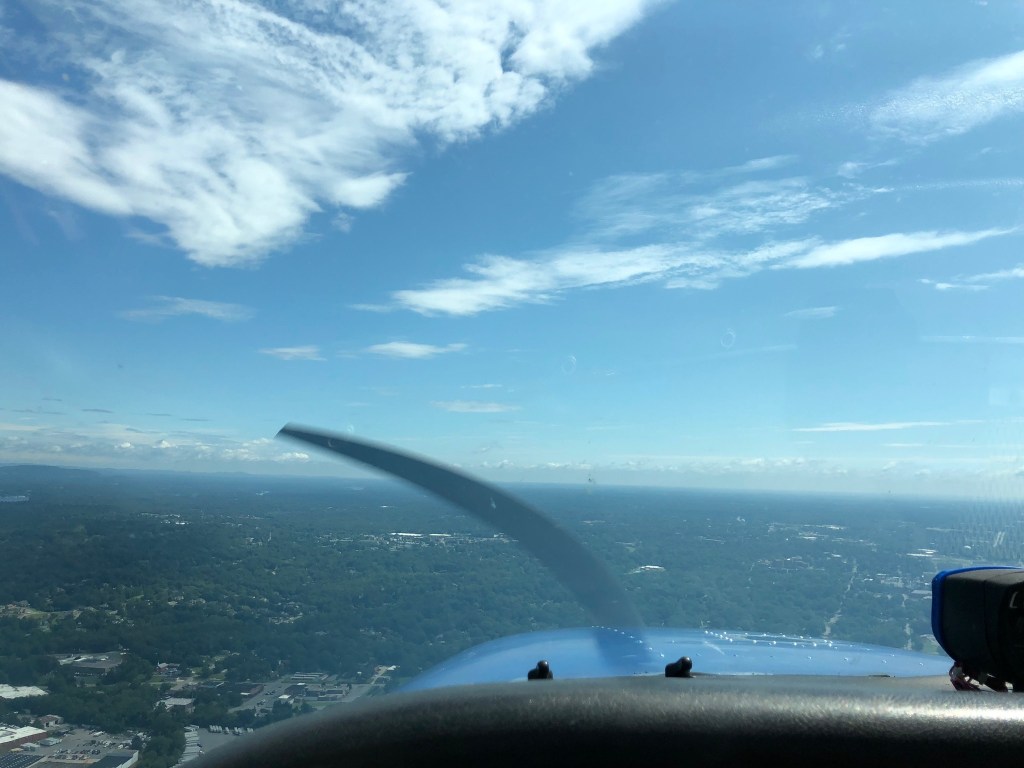
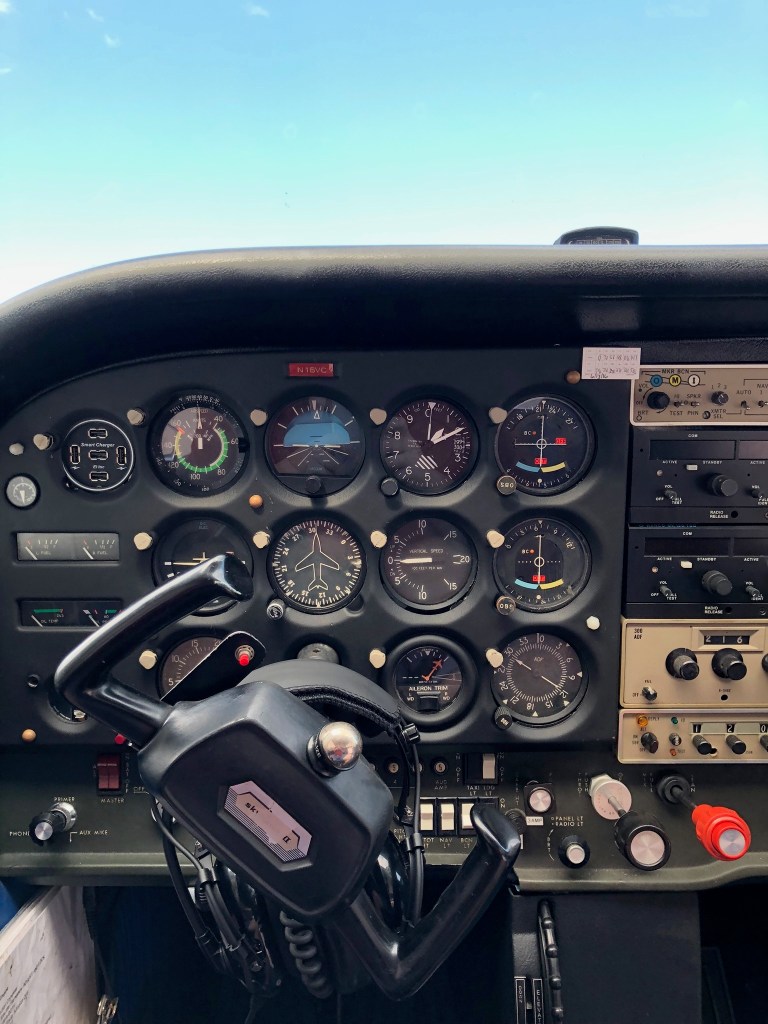
Right: flight controls of the 1976 Skyhawk II before takeoff
In the language of the Abrahamic faiths, reverent resignation to a greater power (fear of the Lord) is the beginning of wisdom, and knowledge of the divine identity is the epitome of understanding (Proverbs 9:10).
Fear is a necessary biochemical mechanism that plays a vital role in the life-cycle; It is an essential component of the drive to survive. The adrenaline rush that activates fight-or-flight responses often empowers us to get to the heart of a matter and take swift action.
Fear can also distort our perception of reality. It was Kipling who said, “of all the liars in the world, sometimes the worst are our own fears.”
Unbridled fear takes on its own life. Left unchecked, fear can drag us into a state of introversion that inhibits healthy ambition and curiosity. It can also push us toward bombastic extroversion, which fills relational space between people and groups with sarcasm masquerading as gravitas. Unhealthy manifestations of existential anxiety keep us from asking critical questions of ourselves, our relationships, and the world.
We humans live in constant fear of being left out, losing our job, getting a bad grade, or catching some incurable virus. We construct thought-worlds on the shifting sand of self-reliance because we are too scared to trust the intentions of others. We convince ourselves that this way of living is the only realistic option. We know we are embracing a lie as truth, but that knowledge only intensifies the vehemence with which we affirm fear’s power. We dare not question its hold on us, for it might take revenge and push us over the precipice into the bottomless cavern of nihilism.
Our internalized terrors are both the cause and consequence of the systemic problems facing our world.
We allow politicians and pundits to stoke our fears. We offer no challenge when they create wedge-issues that drive us apart and turn earnest talk of unity and peace into tropes on sarcasm. In the world we’ve constructed, serious candidates for public office are those who talk like revolutionaries while leaving the logic of fear unchallenged.
The methods of argumentation employed by conflicting parties cannot be distinguished; only the talking points differ. This truism holds across time and context. One group recognizes they have no valid alternative to the divisive politics of the powerful, so they instill fear in the hearts of their supporters. They hope a solution to the world’s problems will present itself after they have beaten their deplorable disputants. Meanwhile, the powerful ignore frustrated cries for truth and justice, choosing dishonor over courage. Trust erodes. Systems break down. Then, the roles reverse, and the cycle repeats.
Truly, there is nothing new under the sun (Quohelet 1:9). Everything stays the same, because all parties, including “the people” whom our leaders extol (AKA: you and me), are complicit. We don’t want anything to change, because the politics of fear is all we’ve ever known. We’re terrified that the alternative might push us beyond our comfort zones, dump us out of our safe spaces, and into the unguarded abyss below.
In an uncertain world, the opposite of unhealthy fear is not courage, but trust. Student pilots understand this truth as well as anyone.
Without trust, flight training is a dangerous waste of time. When fear lies, new pilots don’t have the experiential resources they need to chart a path toward safety. Trust is required, but it is also risky, especially when you barely know the person who is ultimately responsible for keeping you from falling out of the sky.
Pilots strive toward minor goals on their way toward more significant achievements. The first of these goals is the ability to fly solo. Yet, when reliance on an instructor burgeons into confidence in one’s own talents, the element of trust does not go away. At a minimum, solo-pilots must embrace the things they have learned from their instructor. They must also have confidence in the mechanics who service their crafts and the tower operators who make sure they don’t knock each other out of the sky.
Trust is irrational within fear’s logic-paradigm. To trust is to embrace a surprisingly absurd prospect. It is to confess that the final word on life should not belong to our knee-jerk reactions, preconceived notions, and comfortable prejudices. Flight school taught me to embrace this absurd confession and confront the lies fear tells with trust.
We cannot always remain in the safety of a caregiver’s arms. Sometimes we have to stretch out our hands and grab life’s yoke for ourselves; Even so, it is the safety of that grounding embrace and the knowledge conveyed by encounters with the wisdom of others that empower us to confront the distorted logic of fear.
Until we are willing lock hands across boundaries and do battle with the fears that keep us securely fastened in our safe spaces, progress, whether personal or political, will remain paralyzed.
Image of King Air C90B and Cessna Skyhawk in flight are from Wikimedia Commons. All other photos were taken by the author.
 Any Frontier